
A Social History of the Word Godspeed
Few words in the English language carry as much weight in as few syllables as “godspeed.” It feels ancient for good reason—it is—and it sounds like a benediction because that was precisely its intended purpose. Centuries before its present-day use as a name on a hoodie or on the chest of a streetwear shirt, godspeed was said out loud to travelers who risked never coming back. That history influences how the word lands now, whether it shows up in a poem, a film, or among godspeed shirts on a store rack.
Throughout this article, we follow the journey from its medieval roots to its modern life as a label name and fashion statement. Along the way, it answers the question a lot of people search for directly: what is godspeed, and why does it still resonate centuries after it was first spoken as a farewell.
Uncovering the Real Origins of the Term Godspeed
Godspeed wasn’t originally a standalone word. It began as a phrase, “God spede you,” recorded in English texts as early as the 14th century. Though “spede” is the Middle English root of “speed,” it did not signal velocity the way the word does now. Its meaning centered on prospering and being favored by fortune. So when someone said “God spede you” to a traveler, a soldier, or a merchant heading out on a long journey, they were asking for divine help with the whole venture, not just a fast trip.
By the 1500s the phrase had contracted into “godspeed,” a single compact word that showed up in letters, sermons, and everyday farewells. It appears in the King James Bible, in the Second Epistle of John, where the writer warns against giving “godspeed” or blessing to false teachers. That solitary biblical mention cemented the word’s tie to sincere, weighty well-wishing rather godspeed hoodie than casual chit-chat.
Shakespeare used variations of the phrase across several plays in the late 1500s and early 1600s, reinforcing its place in the literary English of the era. By the time it reached broader popular usage, the word had absorbed centuries’ worth of meaning linked to risk, distance, and the hope for a safe return.
Godspeed Meaning: That’s More Than a “Goodbye”
Even now, in 2026, the meaning of godspeed holds more depth than a basic replacement for “bye” or “see you later.” At its core, godspeed is a wish for success and safety extended to someone about to face something uncertain. It conveys three overlapping ideas simultaneously: a blessing, a farewell, and a vote of confidence.
Other parting words make for a useful comparison. “Goodbye,” a contraction of “God be with ye,” holds a spiritual lineage with godspeed, though habitual use has softened it into a near-reflexive phrase. “Farewell” centers on the parting itself, wishing someone well as they go. Godspeed is distinct because it pointedly invokes favorable results and safety, not just a pleasant journey. It is the word you say when the moment carries real weight.
That is precisely why it comes back at high-stakes moments in life today. Mission control at NASA has relied on “godspeed” to dispatch astronauts into orbit since the space program’s earliest years, most notably to John Glenn in 1962 before his landmark orbital mission. Military units have used it for departing soldiers. Coaches have called on it for teams heading into a final match. It is the word chosen when everyday speech falls short for the moment.
Godspeed’s Place in Contemporary Culture
Pose the question to a younger crowd what is godspeed today and you will get a different set of answers than you would have gotten fifty years ago. The word has moved beyond religious services and rocket launches into music, cinema, and apparel labels. It appears in song lyrics across genres, from hip-hop to indie rock, almost always conveying that identical undercurrent of optimism shadowed by uncertainty.
The word has also turned into a name people give to bands, films, and creative projects specifically because of its layered emotional charge. One single word that means “go, and may things go well for you” is useful shorthand for artists aiming to distill a complex sentiment into a name. Such flexibility is part of why godspeed has held on so persistently next to other bygone English phrases that simply died out.
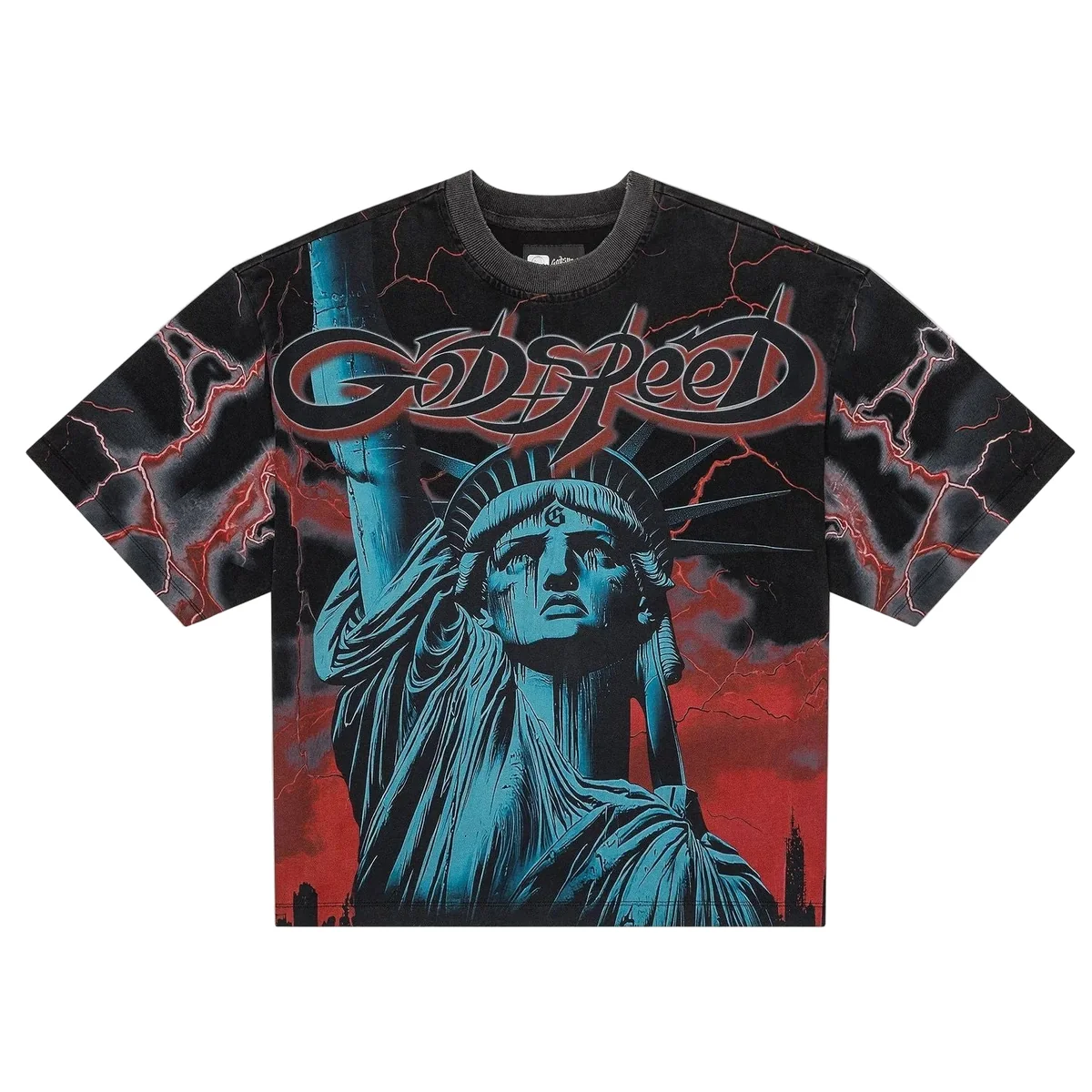
Specifically inside streetwear and fashion circles, godspeed has acquired an additional layer of significance: identity. A godspeed hoodie or godspeed shirt is not just pointing at its literal dictionary meaning. It borrows the word’s emotional resonance, that sense of pushing forward despite hardship, and reshaping it as something you can wear. The term functions as a private mantra rather than just a farewell to someone else.
Godspeed Shirt and Godspeed Hoodie Culture
Fashion has consistently pulled expressions from historical, religious, and folkloric roots to express something the wearer cannot say as efficiently in one sentence. This is precisely the function a godspeed shirt or godspeed hoodie plays within someone’s closet. In place of a logo that merely indicates a company’s name, the term on its own bears generations of accumulated meaning about endurance, blessing, and pressing onward through uncertainty.
This is apart from generic god speed clothing that leans on the phrase decoratively without context. When a brand builds an identity around the word godspeed in particular, the clothing becomes a kind of statement piece. It speaks to resilience and deliberate meaning rather than just occupying blank space on a graphic tee. That distinction matters to shoppers who read labels closely and want their clothing to mean something beyond the stitching.
Below is a comparison of how the word functions across different contexts, which helps clarify why it fits so seamlessly with apparel.
| Situation | Historical Window | Core Meaning Conveyed | Modern Equivalent |
|---|---|---|---|
| Send-off spoken to journeying travelers in medieval times | Spanning the 14th–16th centuries | Safe travel and good fortune | Featuring “Good luck out there” |
| Its use within scripture (2 John) | Text from the 1st century, translated in 1611 | A solemn blessing or backing | Featuring “I stand behind you” |
| NASA’s launch operations | 1962–present | A farewell issued ahead of a dangerous mission | “You’re cleared, go safely,” it states |
| Hoodies and shirts bearing Godspeed | 2010s–2026 | Inner grit paired with continual progress | Featuring “Keep going, no matter what” |
What stands out in that table is consistency. Spanning nearly 600 years, the word has preserved its emotional center even as the situations it describes shifted entirely. Endurance like that is hard to find, and it is a big part of why the word still carries weight printed on a hoodie instead of feeling like a worn-out phrase.
The Case for Godspeed as a Wearable Statement
Vocabulary picked for fashion labels tend to fall into two categories: invented terms with no history, or borrowed words with deep history that get revived for a fresh audience. Godspeed sits firmly in the second category, and that gives it an advantage. People do not need the word explained to them the first time they see it on a shirt. Something about the sound of it already registers as sincere, even if they cannot immediately place the origin.
There’s also a functional reason behind why godspeed comes across effectively in print. It is a one-word phrase, easy to print large and bold across a chest or back panel without needing extra design elements to fill space. Compact, impactful words with deep roots are exactly what graphic apparel designers seek out because they are legible even far away, whether on a hoodie in a crowded room or a shirt glimpsed across a street.
Where a brand carries the name Godspeed, that history becomes the foundation of everything else. The name is not decorative. It traces directly to centuries of people saying, in one form or another, “go, and may it go well for you.” That sentiment suits clothing meant to be worn during activity, exertion, and everyday progress, which is the exact emotional territory street style and sport-inspired apparel already inhabit.
The Word’s Staying Power Heading Into 2026
Language historians often point out that most archaic blessings and farewells have simply vanished from ordinary conversation. No one utters “fare thee well” anymore without a hint of irony. Godspeed has escaped that same decline, and the reasons are worth naming directly. To begin with, it has stayed relevant in consequential, real-world moments like spaceflight departures and military farewells, and this keeps the word present in press coverage and collective memory. Additionally, it has a clean, modern sound despite its medieval origin, making it simple to embrace without sounding costume-like or forced.
Third, which is especially pertinent here, it has been picked up by culture-makers, musicians, filmmakers, and clothing brands, who keep introducing it to new generations of listeners and viewers who subsequently search for the meaning of godspeed and uncover the identical multi-layered history already discussed. Each new instance of this discovery adds another small layer to its cultural history while leaving all its earlier layers intact.
Such durability is uncommon for a single word, and that is precisely why it serves as a solid basis for a clothing brand as opposed to a short-lived trend. A godspeed shirt made in the present day holds the identical underlying meaning of a blessing given to someone setting out on a journey 600 years ago. Few words in any wardrobe can claim that kind of continuity, and that history is precisely what gives the word its quiet weight each time someone wears it.